
Founding Vision
The Center for Third World Organizing (CTWO) was founded in 1980 by welfare rights organizers Gary Delgado and Hulbert James. In response to the social, political, and economic challenges facing communities of color in the 1970s—and the lack of a racial analysis within mainstream organizing networks—they envisioned an institution by and for people of color.
CTWO was created to combine political education, organizing strategy, and direct action in pursuit of racial justice. Its founders believed that real, lasting social change must come from communities most affected by inequity leading their own movements.
The name “Third World” reflects a commitment to global solidarity and shared struggle. It recognizes that liberation is not an isolated project, but a collective effort among oppressed peoples whose experiences of colonization, exploitation, and resistance are deeply interconnected.
0
+
Trainings Per Year
0
+
Cities Reached
0
+
Individuals Trained
CTWO in the 80’s
1980: CTWO is founded in Oakland, California.
1981: Launches the first Organizing People of Color training sessions, held in cities across the U.S.
1984: Establishes the Minority Organizing Training (MOT) program—a yearlong training and on-site consultation for organizers of color.
1985: Pilots the Minority Activist Apprenticeship Program (MAAP), placing its first interns with the Farm Labor Organizing Committee (FLOC) in Toledo, Ohio.
1989: Hosts Weaving the Cloth of Resistance, a groundbreaking gathering for women organizers and leaders.
Late 1980s: Launches the Campaign for Accessible Health Care, securing 30,000 measles vaccinations in Alameda County and developing a model for multiracial organizing that led to the creation of PUEBLO (People United for a Better Life in Oakland).
CTWO in the 90’s
As a CTWO project, PUEBLO spearheaded several landmark efforts:
1992: Won the first lead prevention and treatment program west of the Mississippi.
1993–94: Began organizing around police accountability in Oakland.
1995–96: Co-founded the Kids First Coalition, passing a $90 million youth services fund through a citywide initiative.
1997–98: PUEBLO becomes an independent organization.
The 1990s: Expanding National Reach
1990: Opens a national training and retreat center in Oakland—affectionately called “The Mansion”—to host trainings, retreats, and leadership programs.
1992: Launches the Campaign for Community Safety and Police Accountability (CCSPA), bringing together 15 partner organizations nationwide to address crime and safety through a racial justice lens.
1993: Begins the ANCHOR project (A New Collaborative for Hands-On Relationships), testing new ways to bridge immigrant and long-term resident communities.
1995: Introduces Community Action Trainings (CATs)—three-day intensive programs for grassroots activists. To date, more than 4,000 organizers have participated in CAT trainings across the country.
The 2000s:
Leadership Development and Cross-Sector Collaboration
2000: Launches GROWL (Grassroots Organizing for Welfare Leadership), in collaboration with the Applied Research Center. GROWL united over 30 grassroots welfare rights groups led by women of color to influence national welfare policy.
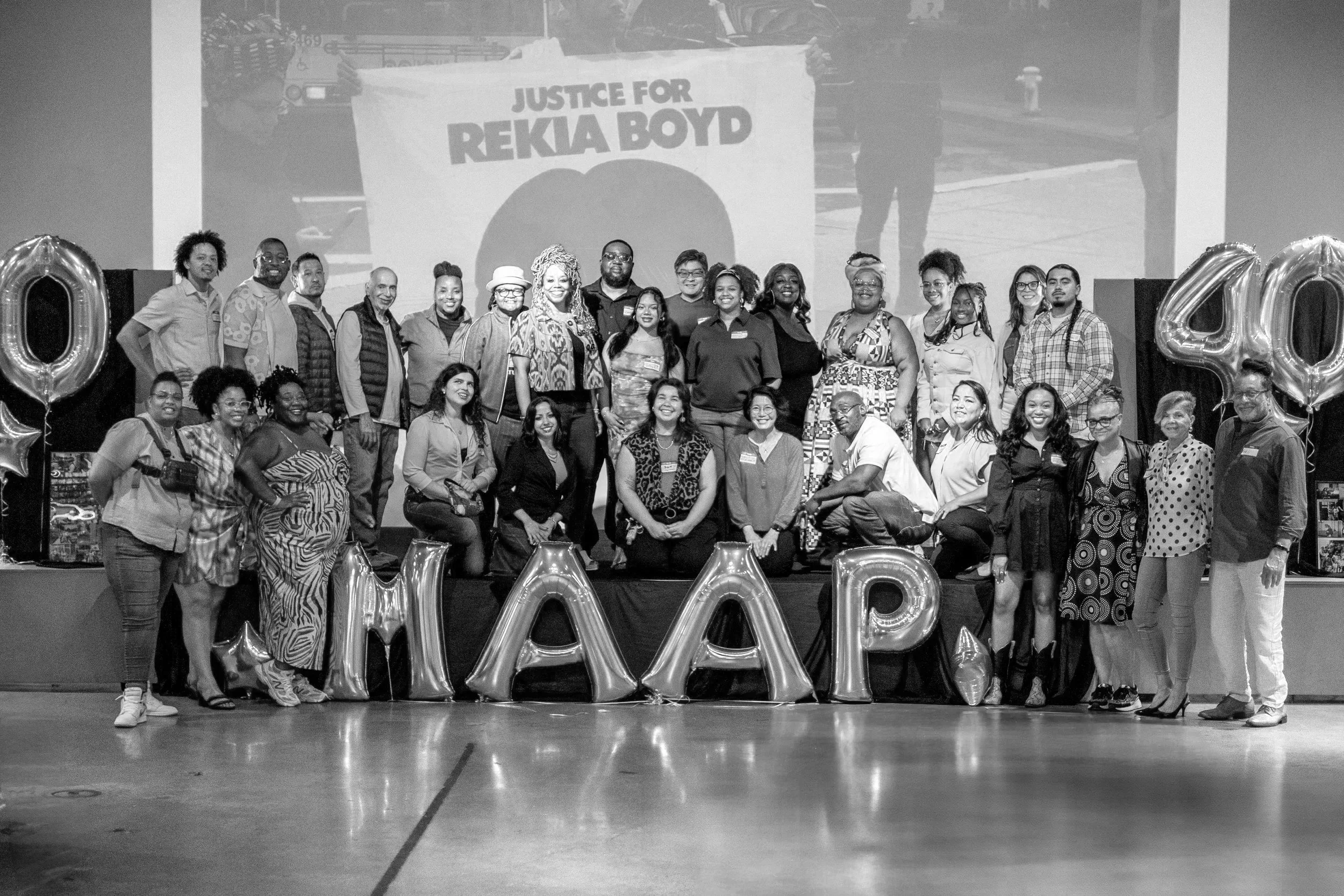
2004: Celebrates MAAP’s 20th anniversary with over 150 alumni and supporters at a graduation and anniversary banquet in Oakland.
2005: Partners with the UC Berkeley Labor Center to create the California Lead Organizing Institute (CLOI)—a shared learning space for senior organizers across labor and community sectors. Over 100 organizers have been trained through CLOI, strengthening cross-sector movement leadership.
2010–Present:
Nurturing Black-Led Organizing
2009: Launches the Black Organizing Project (BOP) in Oakland to build local leadership and issue campaigns. After organizing more than 3,000 members, BOP becomes an independent organization in 2012.
2011: In partnership with Social Justice Leadership, creates Black Organizing for Leadership and Dignity (BOLD)—a national initiative developing Black organizers and movement directors through programs like Amandla!.
2013: Introduces Reel Justice: Our Stories, Our Way, a six-week fellowship empowering young organizers of color to use media for movement building. Fellows learn storytelling, video production, and framing techniques to shape narratives and win public campaigns.
2020: CTWO merges with the BlackOUT Collective and the Ruckus Society to form the CTWO Hub.
Our Legacy
For over four decades, CTWO has remained a training ground, incubator, and catalyst for organizers of color leading transformative justice movements nationwide. Its legacy continues to live through alumni, partner organizations, and the many independent initiatives born from its programs—each carrying forward the vision of a world rooted in solidarity, dignity, and liberation for all.